
How to Reduce Patient No-Shows With Smart Reminder Workflows
💡 Medical practices can cut patient no-shows by as much as 75% using smart reminder workflows. These automated systems send appointment...
10 min read
Alvin Amoroso : Updated on July 22, 2026
An empty chair in your waiting room looks harmless. It isn't.
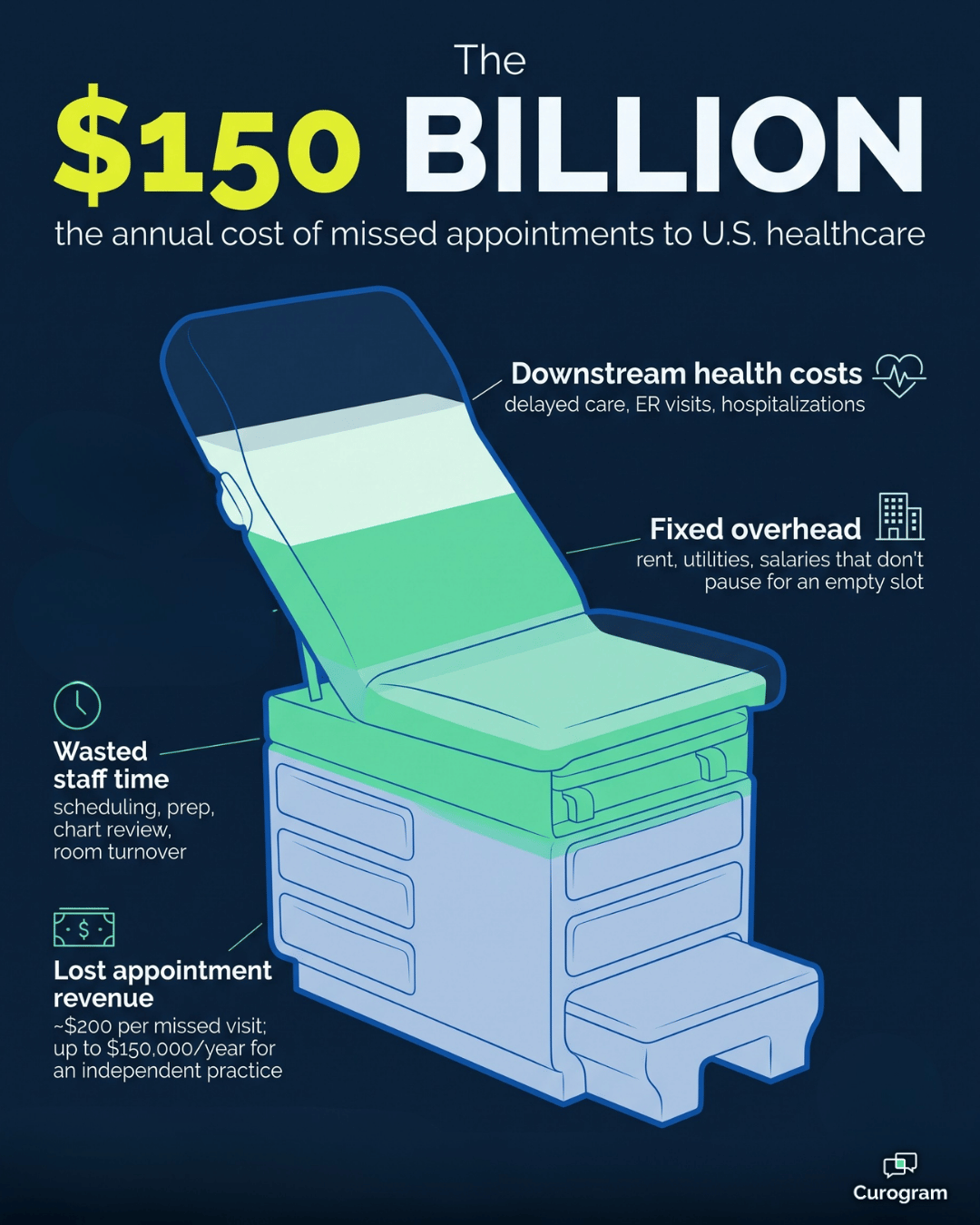
Every missed appointment is lost revenue, wasted staff time, and a patient who didn't get the care they needed. Multiply that across a full year, and the damage adds up fast. Missed appointments cost the U.S. healthcare system roughly $150 billion a year, and your practice quietly pays its share.
The average patient no-show rate is one of the most underrated numbers in healthcare. Most practices track it loosely, if they track it at all. Yet it shapes your revenue, your schedule, and your patients' health outcomes every single week.
This guide breaks down what that rate really means and why it deserves your attention. You'll see current benchmarks, including the average no show rate for primary care, plus a simple way to calculate the number for your own practice.
From there, we'll walk through proven strategies to lower it, strengthen patient communication, and protect your bottom line.
When a patient fails to show up for an appointment, the empty chair represents far more than a 20-minute gap in the schedule. The financial repercussions are profound and multifaceted, extending beyond the immediate loss of consultation fees.
Understanding this total cost is essential for motivating change and investing in effective reduction strategies.
The most obvious cost is the money tied to that appointment slot. A single missed visit is estimated to cost around $200, and those losses stack up quickly. For an independent physician practice, that can mean $150,000 or more slipping away each year.
Here's how fast it happens for a small practice with just two no-shows a day, assuming $100 in reimbursement per visit.
| Missed appointments | Lost revenue at $100 per visit |
|---|---|
| 2 per day | $200 |
| Per week (about 10 visits) | $1,000 |
| Per year (about 500 visits) | Over $50,000 |
For your team, that's roughly a full salary walking out the door — money you could have put toward new equipment, staff training, or facility upgrades. Seen this way, the average patient no-show rate isn't a scheduling nuisance. It's a serious financial liability.
The financial drain doesn't stop at lost revenue. Your practice incurs costs simply by being open and ready to serve patients. When a patient doesn't arrive, the resources allocated for their visit are wasted.
This includes:
Perhaps the most critical, yet least discussed, cost of a high average patient no-show rate is the negative impact on patient health. Missed appointments disrupt the continuity of care, which is especially dangerous for patients with chronic conditions like diabetes, hypertension, or heart disease.
A missed follow-up can lead to unmonitored conditions, delays in necessary treatment adjustments, and ultimately, poorer health outcomes.
This can result in more severe health complications down the line, leading to more expensive emergency room visits and hospitalizations—costs that are ultimately borne by the healthcare system as a whole and can negatively affect a practice's value-based care metrics.
Nationally, the average patient no-show rate across all medical specialties typically falls between 5% and 8%.
However, this figure is a broad generalization and can be misleading. The reality is that no-show rates vary dramatically depending on the specialty, patient population, and geographic location. Some clinics, particularly in high-demand urban areas or specific specialties, report rates as high as 30% or even more.
Recent data suggests that despite the widespread adoption of automated reminders, nearly four out of ten medical groups have seen their no-show rates increase.
This indicates that a more sophisticated and multi-pronged approach is necessary. Relying solely on a single reminder is no longer sufficient. Practices must analyze their specific average patient no-show rate to understand the scope of their unique problem and tailor their interventions accordingly.
Primary care is the foundation of the healthcare system, and it faces its own no-show challenges. Some data puts the average no show rate for primary care as low as 5% to 7%, while other studies push it into the 18% to 20% range. That's lower than pediatrics (up to 30%) or behavioral health, but still high enough to sting.
A few things drive it. Primary care visits are often booked far in advance, so patients simply forget. A routine check-up can also feel less urgent than a specialist visit for a serious issue.
On top of that, primary care serves a broad, diverse population, including people facing real barriers like unreliable transportation or rigid work schedules. Treating the average no show rate for primary care as its own metric helps you benchmark honestly and build solutions that fit.
To fight no-shows, you first have to understand why they happen. The reasons are rarely simple, usually mixing patient behavior, scheduling gaps, and everyday life. A high average patient no-show rate almost never comes from one cause.
New patients no-show far more often than established ones, mostly because they haven't built a relationship with your practice yet. Age matters too. Younger patients in their 20s and 30s may skip visits due to busy schedules or a lower sense of need, while very elderly patients can struggle with transportation or memory.
Patients with chronic illness attend many visits, so the odds of missing one at some point naturally rise — and those who feel better may talk themselves out of a follow-up.

Scheduling choices shape attendance more than most practices realize.
Sometimes the reason has nothing to do with commitment and everything to do with logistics. A large share of patients, especially in low-income or rural areas, miss visits simply because they lack a ride.
Money plays a role too. Worry over co-pays, deductibles, or treatment costs pushes some people to avoid care they know they need. Add inflexible work hours or a lack of childcare, and attending an appointment during business hours becomes nearly impossible.
You can't manage what you don't measure. Calculating your specific average patient no-show rate gives you a baseline, shows whether your changes are working, and reveals the real financial impact on your practice.
The formula is simple:
Divide the number of missed appointments by the total number of scheduled appointments in a period, then multiply by 100.
For example, 25 no-shows out of 500 appointments is a 5% no-show rate.
To get useful numbers, follow three steps.

Once you understand your average patient no-show rate and what's driving it, you can build a layered plan to bring it down. No single tactic fixes everything, but together these strategies make a real dent.
This is the cornerstone of any no-show strategy.
Modern patients expect modern communication, and a good reminder system meets them where they already are.
|
Worth knowing: Two-way reminders are the single highest-leverage change you can make. After switching to Curogram's automated, two-way texting, Atlas Medical Center cut its no-show rate from 14.2% to 4.91% in three months — about 3x better than the industry average. With SMS open rates near 98%, the message almost always gets seen. |
A written policy sets clear expectations from day one. Share it with every new patient, post it on your website, and display it in the office.
Charging a fee for missed visits can be a strong deterrent, but a rigid rule can push patients away. Many practices succeed with a "first-time forgiveness" or "three strikes" approach that waives the first miss. Frame the policy as fairness, not punishment: a missed slot is a slot another patient couldn't use.
The way you build your schedule directly affects the average no show rate for primary care. Start by trimming wait times — use your practice data to find bottlenecks and smooth out check-in.
When patients trust that you respect their time, they respect the slot in return.
From there, add flexibility and a safety net.
The right tools take pressure off your team and give patients more ways to stay on track.
A patient who feels valued is far less likely to disappear. Encourage providers to spend a moment building rapport, since a strong patient-provider bond is a powerful motivator for showing up.
Make sure patients understand why follow-ups matter for their health, and treat communication as more than reminders. A welcoming, supportive experience improves
The strategies above will move the needle. To pull ahead, it helps to think a little differently about the average patient no-show rate.
Understanding why patients miss appointments on a psychological level can unlock new strategies. Sometimes it's simple forgetfulness. Other times it's driven by fear—fear of a diagnosis, fear of the cost, or even anxiety about the procedure itself.
Training staff to be empathetic and supportive during scheduling and reminder calls can help alleviate some of this anxiety.
Language matters. Instead of a sterile reminder, a warm, personal message can make a significant difference.
Your practice management system is a goldmine of data. By analyzing your historical average patient no-show rate, you can identify patterns.
Do patients scheduled for longer appointments have a better attendance rate?
Are no-shows more common in the afternoon?
Using this data to make small, informed adjustments to your scheduling templates can yield significant improvements over time.
You'll never eliminate every missed appointment. But you can stop treating them as background noise you've learned to live with.
The practices that win here do a few things well. They measure their average patient no-show rate honestly. They send reminders patients actually respond to. And they make it easy for people to confirm, reschedule, or ask for help.
Start with one change. Track your baseline for a month, then layer in automated, two-way reminders and watch the number move. Small, steady adjustments compound into fewer empty chairs and steadier revenue.
Better patient communication does more than protect your schedule. It builds trust, supports patient retention, and keeps care on track for the people who need it most.
Ready to turn missed appointments into kept ones? See how Curogram helps practices reduce no-shows with automated reminders and secure two-way texting built for busy front desks.
A typical no-show fee can range from $25 to $100 or more. The amount often depends on the medical specialty and the length of the appointment. A common fee is around $50. It's crucial that the fee is clearly communicated in the practice's financial policy, which patients should sign before their first appointment. Some practices choose to charge the full cost of the scheduled service, particularly for longer, more involved appointments.
The no-show rate is calculated with a simple formula: divide the number of missed appointments by the total number of scheduled appointments over a specific period, and then multiply the result by 100 to get a percentage. For example, if a clinic had 50 missed appointments out of a total of 1,000 scheduled appointments in a month, the no-show rate would be (50 / 1000) * 100 = 5%.
The average number of patients a primary care physician sees per day varies widely but typically falls within the range of 20 to 30 patients. However, this can be influenced by factors like the type of practice (e.g., urgent care vs. private practice), patient complexity, and the efficiency of the clinic's workflow. Some physicians in high-volume settings may see 40 or more patients daily.
Patient retention rate is a metric that measures the percentage of existing patients a practice retains over a specific period. It is calculated by taking the number of patients at the end of a period, subtracting the number of new patients acquired during that period, dividing by the number of patients at the start of the period, and then multiplying by 100. A high patient retention rate is a strong indicator of patient satisfaction and loyalty.
Yes, when they're done well. Automated, two-way reminders that ask patients to confirm or reschedule work far better than a single passive alert. The right cadence — a note at booking, one about a week out, and a final nudge 24 to 48 hours before — keeps the visit top of mind and gives patients an easy way to respond.
💡 Medical practices can cut patient no-shows by as much as 75% using smart reminder workflows. These automated systems send appointment...
💡The best approach to handling patient cancellations blends prevention with fast, kind follow-up. Prevention starts with clear policies, automated...
Missed appointments are a significant drain on resources, revenue, and operational efficiency for healthcare practices. Understanding how to remind...